
THE MARQUESAS
Te Henua Enana - The Land of Men
Located 1,400 km northeast of Tahiti, the Marquesas Islands archipelago comprises 12 volcanic islands, 6 of which are inhabited. They are the youngest islands of French Polynesia, so recent that coral has not yet had time to form lagoons. The first Europeans arrived in 1595, before Polynesia was annexed by France in 1842. Since 2024, the entire archipelago has been a UNESCO World Heritage Site.
Two Marquesan dialects are still spoken there today, one in the north, the other in the south. A culture — language, sculpture, tattoos, dances, songs — that the Marquesans keep alive and pass on despite attempts to erase the past, and which, in its time, influenced artists like Paul Gauguin and Jacques Brel.
We are children of this land. Before us, it saw our parents and grandparents grow up. It sustains us today, as it will continue to sustain those who come after us. What we experience here, we who grew up here, is what we want to share with you.
NUKU-HIVA
© Grégoire Le Bacon
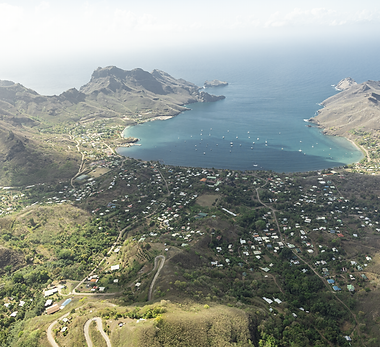
The administrative capital of the archipelago, Nuku-Hiva is also the second largest island in French Polynesia after Tahiti. Among its treasures lies the Vaipo waterfall, the highest in French Polynesia with a drop of approximately 350 meters.
This is where we grew up. It's not simply the island where our house is located — it's the one that shaped us, and that we know from the inside, like you know a place you've never really left.
UA-HUKA

© Grégoire Le Bacon
Ua Huka is a place of contrasts: arid plateaus where the horses that give it its nickname roam semi-freely, and verdant valleys that are home to one of the largest citrus arboretums in the Pacific, as well as several endemic bird species such as the Pīhiti (ultramarine lory).
The island also has several museums dedicated to archaeology, the sea and wood, bearing witness to a local craft particularly renowned for sculpture.
TAHUATA

© Tahiti Tourism
Tahuata: its name means the arrival of daylight — a fitting name, since it was here that the first Western gaze fell upon the archipelago, in 1595. Thanks to some coral formations, Tahuata has several white sand beaches, particularly sought after in the archipelago.
From Hiva-Oa, we go there for the day. Tahuata is much more than white sand beaches, it's a real change of scenery, a way to escape from everyday life.
UA-POU

© Sylvain Lefevre
Instantly recognizable by its basalt peaks, Ua Pou enjoys a particularly dry climate, unlike the southern islands of the archipelago. It is also one of the few places in the world where you can find flower stone, a rare rock adorned with natural flower-like patterns.
We have been there several times and we understand why those who live there would not trade it for any other island.
HIVA-OA

© Tahiti Tourism
The second largest island in the Marquesas and the third largest in French Polynesia, Hiva Oa is known for having been the final years of Paul Gauguin's life; he is buried there today alongside Jacques Brel. The island also boasts important archaeological sites, which, like the rest of the archipelago, have been listed as UNESCO World Heritage sites since 2024.
We lived there for a few years. This island, which is not originally ours, welcomed us as if it were our own.
FATU-IVA

© Lionel Gouverneur
The most remote island in the archipelago, Fatu Iva is accessible only by boat. Life still revolves around the beat of tapa, an ancestral fabric made from bark, and the fragrant scent of umuhei , bouquets of aromatic flowers. Its emblem: the Bay of Virgins, considered one of the most beautiful bays in the world.
This is our favorite island; it retains something intact, as if preserved from the passage of time elsewhere.